Most small businesses do not fail because the owner worked too little. They fail because the money ran out before the business found its footing, or because the owner built something nobody wanted to pay for, or because a good month hid the fact that the business was losing money on every sale. A business plan does not prevent any of that on its own. What it does is force the owner to answer the hard questions while the answers are still cheap to change — on paper, before the lease is signed and the stock is ordered.
A plan is also the document a bank or an investor asks for first, and the document a sensible owner reads again when a big decision comes up. It does not need to be long. A plan that nobody reads is worse than no plan at all, because it creates the feeling that the thinking has been done when it has only been typed up. This guide works through the eight steps of a real plan, with a choice at the start — lean or traditional — and a worked example running through it: a small home-cleaning business, run by two people, serving one town.
Lean or traditional? Choose before you write
There are two kinds of business plan, and the right one depends on who will read it. A lean plan is a few pages — sometimes a single page — covering the customer, the offer, the costs and the money. A traditional plan is a full document, often ten to twenty pages, with a market section, a competitor section, an operations section and a full financial forecast. Most small businesses need the lean version for themselves and the traditional version only when someone else’s money is involved.
The table below makes the choice simple.
| Lean plan | Traditional plan | |
|---|---|---|
| Length | 2–5 pages | 10–20 pages |
| Best for | Owner decisions, starting small | Bank loan, investor, grant |
| Detail | Key numbers only | Full market, competitor and financial sections |
| Time to write | A focused weekend | One to two weeks |
The steps below build the traditional plan, because it contains everything the lean one needs. If nobody else’s money is involved, stop after the short version of each step and keep the whole thing under five pages. The structure is the same either way, and a lean plan that later needs to become a traditional one is a matter of adding detail, not starting again.
Step 1: Start with the customer and the problem
Every plan starts with the same two sentences: who the customer is, and what problem you solve for them. Our example business serves busy households in one town who want a reliable weekly clean and cannot find a cleaner who turns up on time. That is a customer and a problem in one sentence, and everything else in the plan has to serve it.
Be specific. “Homeowners” is not a customer. “Dual-income households with children, in houses with three or more bedrooms, within twenty minutes of our base” is a customer you can find, count and write to. The narrower the description, the easier every later decision becomes: what to charge, where to advertise, what to promise.
This is also where the size of the opportunity gets checked. How many such households are there in the area? Are they already served, and by whom? A proper market analysis answers those questions with real numbers from the town itself — how many households, what they already pay, whether the number is growing or shrinking. A plan built on “there must be plenty of demand” is a guess wearing a suit. Count first, then write.
Step 2: Know the competition, honestly
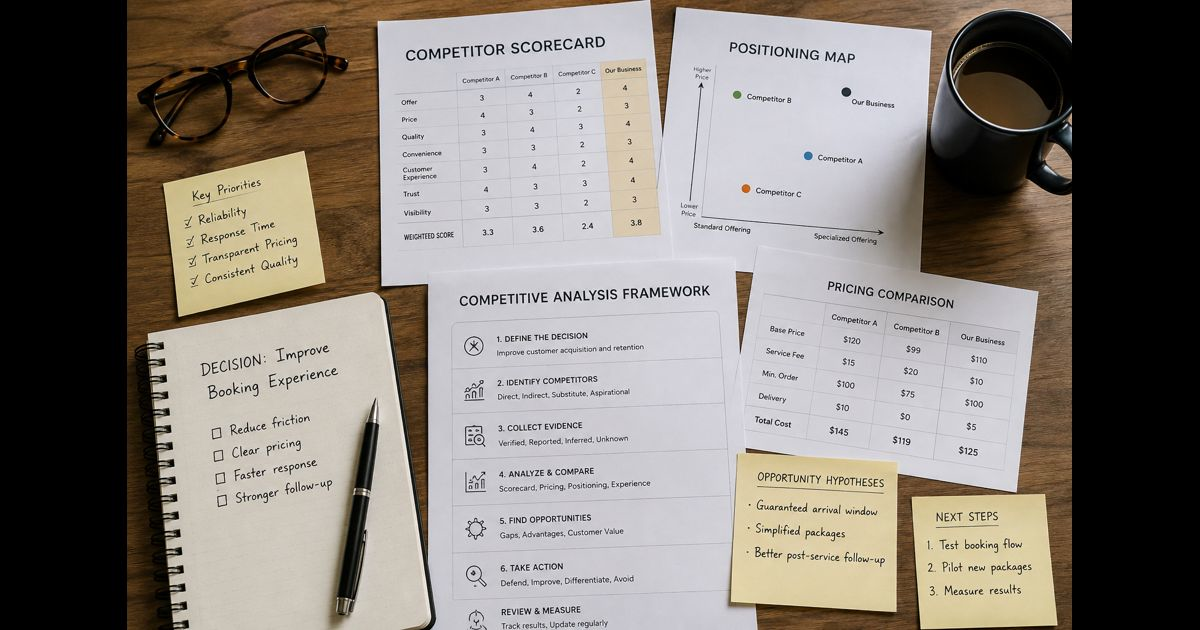
The second step is to look at who already serves your customer and what they do well. Our cleaning business has three kinds of competitor: a national franchise with a strong brand and higher prices, two local cleaners who work alone and charge less, and the customers themselves, who clean their own homes when they have the time. The last one matters most — doing nothing is always the cheapest competitor.
Write down each competitor’s price, what they promise, and where they are weak. The franchise is reliable but expensive and impersonal. The solo cleaners are cheap but hard to reach and sometimes cancel. None of them offers a fixed weekly slot with the same cleaner every time. That gap is the opening: reliability at a fair price, with the same person each week.
Do this with evidence, not with flattery about your own idea. A competitive analysis done properly means looking at real competitors’ websites, prices and reviews and writing down what customers actually complain about. If the plan cannot name a real gap, the business does not have one yet, and it is better to find that out now than after the first month of trading.
Step 3: Describe the business in one page
The business description is the plan in miniature: what you sell, who you sell it to, how you make money, and why you will win. For our example: a weekly home-cleaning service, same cleaner each week, fixed price per visit based on the number of bedrooms, booked online or by phone, serving one town. Money comes from repeat weekly visits, not one-off deep cleans. The advantage is reliability — the same person, the same slot, every week — in a market where the main complaint is cleaners who do not turn up.
Keep this to one page. If it takes longer than a page to explain what the business does, the business is probably trying to do too many things. A plan that describes three different businesses is three plans, and none of them will get written properly. One business, one page, one clear offer.
This section also states the legal basics in a line or two: the business form, who owns it, and where it operates. It is not the interesting part of the plan, but a bank will look for it, and writing it down forces the owner to settle questions that are easy to postpone — who owns what share, who is responsible for what — until they become arguments.
Step 4: Products, services and pricing
List exactly what you sell, and what each item costs the customer. Our cleaning business sells three things: a weekly clean at a fixed price per visit, a fortnightly clean at a slightly higher per-visit price, and a one-off deep clean priced by the job. That is the whole list. Every extra service added later — ironing, oven cleaning, window cleaning — is a decision to make after the core service works, not before.
Pricing deserves its own paragraph, because it is where most small plans quietly fail. The price has to cover the cleaner’s pay, travel, cleaning supplies, insurance, tax, and the owner’s time, and still leave a margin. Work it out from the costs upwards, not from the competitors’ prices downwards. If the honest cost of a visit is higher than what customers in the town will pay, that is the plan telling you something important: either the costs have to come down, or the service has to be worth more, or the business does not work in this form. Finding that out in a spreadsheet is free. Finding it out after three months of trading is expensive.
Write down the price of each service, what is included, and what costs extra. A customer who knows the price before booking is a customer who does not argue about it afterwards, and a business that knows its own prices does not accidentally discount itself out of existence.
Step 5: Marketing and sales, kept simple
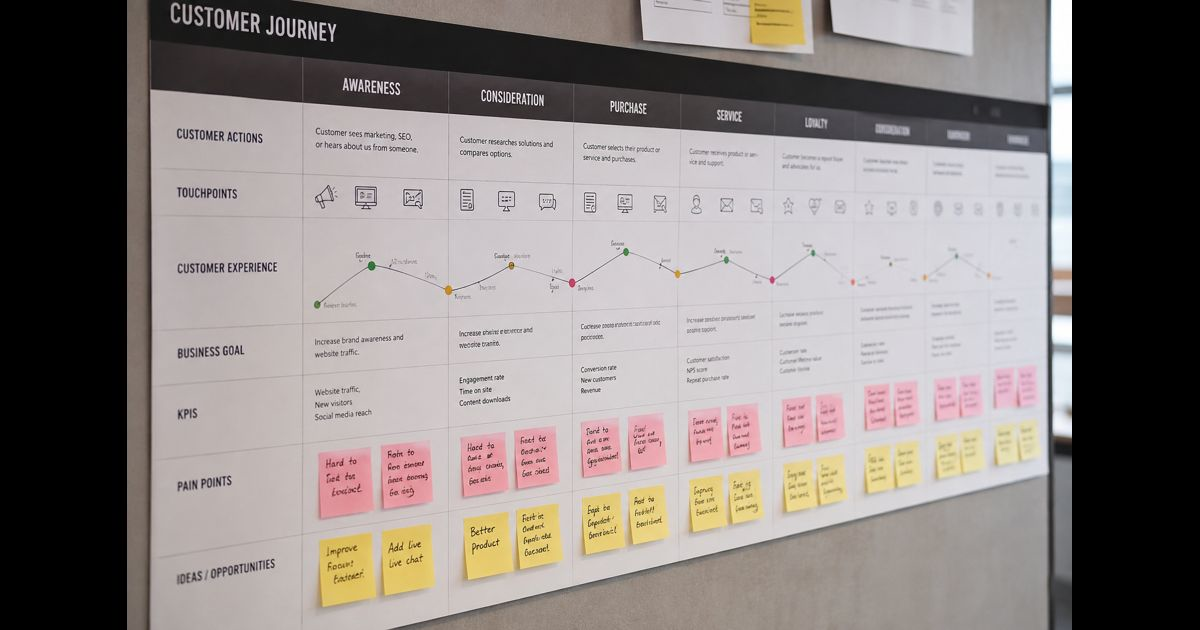
The marketing section of a business plan is often where the writing goes vague — “social media,” “word of mouth,” “local advertising” — as if naming a channel were a plan. It is not. For each channel, the plan needs three things: who it reaches, what it costs, and how you will know it worked.
Our cleaning business has a simple answer. The best customers come from referrals: a happy customer telling a neighbour. So the plan spends its small marketing budget on the things that create referrals — a reliable service, a short note after the first clean asking for a review, and a small thank-you for every customer who sends a friend. The second channel is local search: people in the town typing the service into a search engine and calling the name that looks trustworthy, so the business needs real reviews and a clear price on its website. The third is a leaflet through the doors of the streets it already serves, because a cleaner who already works on a street is the best advertisement on that street.
That is three channels, each with a cost and a measure: referrals counted per month, search enquiries counted per month, leaflet streets counted against new bookings. A marketing section that cannot be measured cannot be managed, and a plan that lists ten channels for a two-person business is a wish list, not a strategy.
Step 6: Operations — how the work actually gets done
Operations is the unglamorous heart of the plan: who does what, in what order, every single week. Our business has two cleaners, one town, and a simple routine. Bookings come in by phone or online and go into one shared calendar. Each cleaner has a fixed round of houses, in street order, so travel time stays short. Supplies are bought once a week from one supplier. A checklist is left in each house after the clean, so the customer can see what was done and the cleaner can see what was missed.
Write down the suppliers, the equipment, and what happens when something goes wrong. What if a cleaner is ill on a Tuesday? Who covers the round, and how is the customer told? What if a customer complains? Who takes the call, and what is offered? A plan that has no answer for a sick day is a plan that has never been tested against a real week.
This section also covers the premises and equipment in plain terms: a van or a car, the cleaning kit, insurance, and where supplies are stored. Keep it factual. A bank reading this section wants to know the business can actually deliver what the earlier sections promise, week after week, not just on a good day.
Step 7: The team
A two-person business still needs a team section, because the plan has to say who does what and what happens if one of them cannot. In our example, one owner runs the bookings, the money and the customer calls, and the other runs the cleaning rounds and trains any new cleaner. Each role is written down with its hours, so the plan shows the business is staffed, not just hoped for.
Be honest about the gaps. If neither owner knows bookkeeping, the plan says so, and says who will do it — an accountant once a month, or a simple system learned before trading starts. A plan that pretends the team can do everything is not reassuring to a lender. A plan that names its gaps and fills them is.
If the business will hire, say when and for what. “We will hire a third cleaner when weekly bookings pass thirty visits” is a plan. “We will hire as we grow” is not. The trigger number matters, because it stops the business from hiring too early and running out of money, or too late and losing customers it cannot serve.
Step 8: The financial plan
The financial section is where the plan either holds together or falls apart, and it has three parts: what it costs to start, what it costs to run each month, and when the money coming in covers the money going out. For our cleaning business, the start-up costs are small — a van deposit, cleaning equipment, insurance, a website, leaflets — and the plan lists each one with its price. The monthly costs are the cleaners’ pay, fuel, supplies, insurance and a small marketing budget. The income is the number of weekly visits multiplied by the price per visit.

The most important number in the whole plan is the cash position week by week, not the profit at the end of the year. A business can be profitable on paper and still run out of cash, because customers pay late, or a quiet month arrives before the busy one. That is why the plan includes a cash flow forecast — a simple week-by-week view of money in and money out, with a 13-week routine for keeping it honest. If the forecast shows the bank balance going below zero in week nine, the plan has done its job: the owner can see it now, while there is still time to start smaller, raise the price, or arrange a buffer.
Keep the assumptions visible. Write down how many customers the forecast assumes, what they pay, and how fast they arrive. A forecast that assumes fifty customers in the first month, with no evidence, is fiction. A forecast that assumes ten customers in month one, twenty in month two, and thirty by month three, with a reason for each step, is a plan a lender can believe.
The executive summary comes last
The executive summary sits at the front of the plan, but it is written last, because it is a summary of the whole thing in one page: the business, the customer, the gap in the market, the money needed, and the money it will make. Anyone who reads only that page should understand the business and want to read the rest. If the summary cannot be written in one page, the plan itself is not clear enough yet, and the summary is telling you so.

For a lean plan, the executive summary plus the one-page business description plus the key numbers is the whole document. For a traditional plan, it is the front door. Either way, write it last, cut every sentence that does not earn its place, and read it out loud. A plan that sounds muddled when spoken will read muddled on the page.
Keeping the plan alive
A business plan is not a document for a drawer. It is a working paper, and it goes out of date the moment the business meets its first real customer. The plan should be reviewed once a quarter, in one sitting, with three questions: which numbers were wrong, which assumptions changed, and what needs to change in the plan because of it. The answers go into the plan itself, in a short update note, so the document stays true to the business instead of becoming a snapshot of a guess made months ago.
That review is also the moment to check the plan against reality. If the business is getting customers from a channel the plan never mentioned, that channel goes into the plan. If a service nobody buys is still in the price list, it comes out. A plan that is updated is a tool. A plan that is filed away is a souvenir.
Mistakes that sink a plan
Too long. A forty-page plan that nobody reads is worse than a five-page plan that gets used every week. Length is not thoroughness.
Invented numbers. A forecast built on made-up customer counts or prices is not a forecast. Every number needs a source — a quote, a competitor’s price, a count of households — or it needs to be labelled as a guess, with the guess kept small.
No cash plan. A plan that shows a yearly profit but never shows the bank balance week by week has missed the number that kills small businesses.
A copied template. A template is a starting point, not a plan. Every section that still reads like it could belong to any business has not been written yet. If the plan could be handed to a different business without changing a word, it says nothing about yours.
Write the plan, test it against the town you actually serve, and let it change as the business does. A good business plan is not a promise that everything will go as written. It is proof that the owner has thought about what happens when it does not.