Most small businesses spend far more energy finding new customers than keeping the ones they already have. The advertising, the offers, the social posts, the networking — all of it aimed at strangers. Meanwhile the customers who already bought once, who already trust the business enough to pay, quietly drift away. Nobody notices, because there is no dramatic moment. They just stop coming back, one at a time, and the business has to find a new stranger to replace each one.
Retention is not a loyalty scheme or a trick. It is the habit of giving a customer a reason to return, and then remembering to ask them back. A small business has an advantage here that a large one does not: it can know its customers by name, remember what they bought, and notice when they go quiet. That personal memory is worth more than any points card, and it costs almost nothing.
This guide builds a retention system for a small team: how to find out why customers leave, how to follow up without being a nuisance, how to reward loyalty without giving the profit away, and how to win back the ones who drifted. It is written for a business with a few hundred customers, not a few hundred thousand, and it fits on a single page once it is built.
Start by finding out why customers leave
Before fixing retention, find out what is actually going wrong. Customers rarely leave for the reason the owner assumes. They leave because something small went wrong and nobody noticed, or because the business never gave them a reason to come back at the right moment, or simply because another business asked them first.
The cheapest way to learn is to ask. Not with a long survey — nobody fills those in — but with one short question at the right moment. After a job is finished, or after a purchase, ask what nearly stopped them from buying, or what would have made it easier. The answers are usually specific and fixable: the opening hours, the wait, the price being unclear, the follow-up that never came. One honest answer is worth more than a month of guessing.
It also helps to look at the business’s own records before asking anyone. Who bought once and never returned? Who used to come every month and now comes every three? Who stopped after a particular job or a particular product? Patterns in the records usually point at the same few moments: a first experience that was fine but forgettable, a second visit that never got an invitation, a problem that was never followed up. Retention work starts by naming those moments, because each one has a different fix.
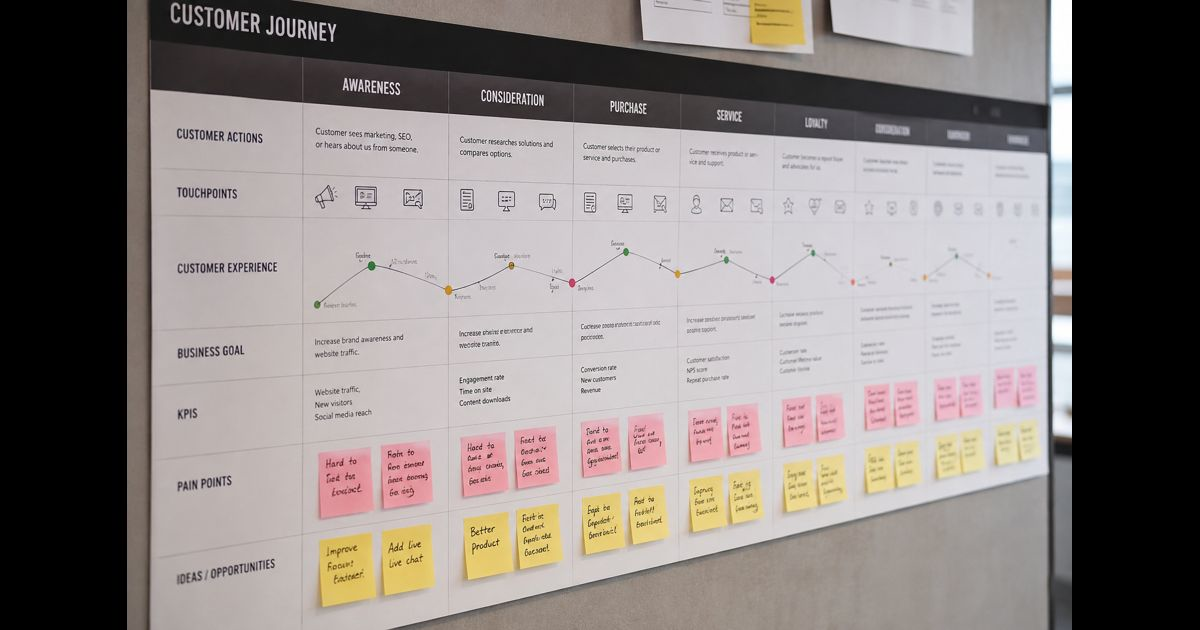
This is where the shape of the whole experience matters. The customer journey — what happens from the first contact to the weeks after the purchase — is where customers are won or lost, and most of the losing happens after the sale, in the silence that follows. A business that maps those quiet weeks can see exactly where a small follow-up would have kept the customer. A business that never looks at them keeps losing people it never knew it had lost.
Make the first experience worth repeating
Retention starts with the first purchase, not the tenth. A customer who had a good first experience will come back without being asked. A customer whose first experience was confusing, slow, or impersonal will not, however good the product was.
Three things make a first experience stick. The first is clarity: the customer knows what will happen, when, and what it will cost, before they pay. Surprises after payment are remembered far longer than surprises before it. The second is a small, human touch: a name remembered, a preference noted, a question answered properly rather than brushed off. The third is a clean finish: the job done as promised, the product as described, and a short message afterwards saying it is done and what to do if anything is not right.
None of this needs a system to start with. It needs the owner to decide that the first experience is a product in itself, designed on purpose rather than left to chance. Write down what a good first experience looks like, step by step, and check it the way the business checks anything else that matters. A customer who leaves thinking “that was easy” is a customer who will come back when the need arises again.
Build a follow-up rhythm that runs itself

The single most useful retention habit is also the simplest: follow up after the sale, at the right time, with something useful. Most small businesses do this once, when they remember, and then never again. The fix is to make it a routine with a fixed timing, so it happens whether anyone remembers or not.
A workable rhythm has three touches. The first comes within a day or two of the purchase: a short message thanking the customer, confirming what was done, and saying what to do if anything needs attention. Its purpose is reassurance, not selling. The second comes when the customer is likely to need the business again — the service interval, the season, the point when a consumable runs out. Its purpose is a useful reminder at the moment the need returns. The third comes only if the customer has gone quiet for longer than usual: a short, honest check-in, not a discount.
Keep every message short, personal, and from a named person. A message that could have been sent to anyone will be read as if it was sent to no one. Use the customer’s name, mention what they bought or what was done, and sign it with a real name. One honest sentence beats a polished newsletter that nobody reads.
And keep the list small to start with. Twenty customers followed up properly beat two hundred sent a generic message. The system grows as the habit holds. A business that follows up with every customer, every time, for three months will know its customers better than any survey could tell it — and the customers will notice, because almost nobody else does it.
Reward loyalty without giving the profit away
Loyalty schemes fail when they are really discount schemes in disguise. A customer who only returns for the discount is not loyal; they are renting their loyalty at a price the business cannot afford to keep paying. Real loyalty comes from being treated well, remembered, and given something that is genuinely useful — not from a permanent price cut.
The rewards that work for a small business are small and personal. Priority booking for regular customers. A first look at something new. A free small extra with a repeat order. A thank-you that arrives when nothing is being sold. These cost little, and they say something a discount cannot say: you are a regular here, and we noticed.
If the business does use a formal scheme, keep it simple enough to explain in one sentence, and make the reward reachable. A scheme that takes a year to pay off will be forgotten long before it is used. A scheme that rewards the fifth visit, or the third order, is close enough to feel real. And never make the scheme the reason to return. The reason to return should be the work itself. The scheme is only the nudge.
There is one more rule worth keeping. Treat the best customers best, openly. The customer who comes every month and recommends the business to friends is worth more than ten one-off buyers, and it is fair to say so in the way they are treated: faster replies, first choice of slots, a direct number. Other customers will notice, and most of them will understand. They would want the same treatment if they came as often.
Win back the customers who drifted away

Every business has a list of customers who used to come and stopped. Most owners assume those customers are gone for good, or that they left angry. Often neither is true. They drifted because life got busy, because the business never asked them back, or because a small problem went unnoticed. A short, honest message can bring a surprising number of them back.
The win-back message has three rules. First, it is personal and specific: mention what they bought, or when they last came, so it is obvious the business remembers them. Second, it asks a question rather than making an offer: is everything all right, was there anything about the last visit that could have been better, is there anything they need now? Third, it accepts the answer. If the customer left because something went wrong, the business should hear it, fix it, and say so. If they simply went elsewhere, the business should wish them well and leave the door open.
Do this in small batches, not all at once. Ten customers a week, with a proper message each, will teach the business more about why people leave than a hundred identical messages sent in an afternoon. And keep a note of what comes back: the reasons people give are the most honest feedback the business will ever get, and they usually point at one or two fixes that would have kept those customers in the first place.
Some customers will not come back, and that is fine. A win-back is not a rescue mission for every lost customer. It is a way of learning from the ones who drifted, keeping the ones who still want to return, and making sure the same quiet drift does not keep happening to the next group.
Measure four numbers, and nothing else
Retention cannot be managed on feeling. It needs a few honest numbers, checked every month, written in the same place. Four are enough, and they all come from records the business already has.
Repeat rate. Of the customers who bought in a given month, how many bought again within the next few months? This is the headline number. If it is rising, the retention work is working. If it is falling, something in the experience needs attention, and the follow-up rhythm is the first place to look.
Time between purchases. How long, on average, between a customer’s first purchase and their second? A business that knows this number can time its follow-up to the moment the customer is likely to need it again, instead of guessing. A follow-up sent at the right time feels helpful. The same message sent at the wrong time feels like noise.
Customers gone quiet. How many customers who used to buy regularly have not bought in longer than their usual gap? This is the win-back list, and it should be counted every month so it never grows quietly into a problem. A list that is counted is a list that gets worked.
What the work costs. The time and money spent on follow-up, loyalty and win-backs, against the repeat business it brings. Retention work should pay for itself, and the only way to know is to write the costs down next to the results. This is the practical use of a simple KPI dashboard for a small business: a few measures that actually drive decisions, in one place, checked on a fixed day, instead of a dozen figures nobody looks at.
Review the four numbers once a month, for fifteen minutes, with the same question each time: what one thing will we change this month? One change, tested for a month, beats five changes made at once and never judged. Retention is a slow compounding habit. The businesses that keep their customers are rarely the ones with the cleverest scheme. They are the ones that measured, followed up, and kept going when the results were still small.
A worked example: a neighbourhood bakery
Take a small neighbourhood bakery with a few hundred regular customers. Most of them buy bread once or twice a week. The owner notices the till is steady but the same faces are slowly disappearing, replaced by new ones who also disappear. The business is always busy finding customers and never ahead.
The owner starts with the records. The quiet customers are easy to spot: people who used to buy every week and have not been in for a month. The pattern is not anger — it is drift. There was no follow-up, no reason to return on a particular day, and no memory of what they usually buy.
The fix is small. A short thank-you note with the first order after a gap, naming what they bought. A reminder on the day their usual loaf is baked fresh. A simple card: every fifth loaf free — reachable, easy to explain, and tied to the product itself, not a discount on everything. And once a week, ten short messages to customers who have gone quiet, asking honestly if everything was all right with their last visit.
After three months, the repeat rate is up, the quiet list is shorter, and the owner knows something the till never said: most of the drifted customers had not left for a competitor. They had simply never been asked back. The system that fixed it costs an hour a week, and it is the same system any small business can run — follow up, remember, measure, and keep going.
Common mistakes to avoid
Chasing new customers while ignoring the old ones. A business that spends all its marketing time and money on strangers will always feel busy and never feel secure. The customers already won are the cheapest growth the business has. Give them a share of the attention that matches what they are worth.
Discounting loyalty into a loss. A reward that costs more than the repeat business it brings is not a retention strategy, it is a slow leak. Check the numbers every month. If the scheme does not pay for itself, change the reward, not the customers.
Automating the personal away. A message that reads as if it was sent to everyone will be treated as if it was sent to no one. Keep the customer’s name, the last purchase, and a real signature in every follow-up. The moment retention becomes fully automatic, it stops being personal — and personal is the small business’s only real advantage.
Treating retention as a campaign. A loyalty push for a month, then nothing for a year, does not retain anyone. Retention is a weekly habit, like bookkeeping: boring, regular, and quietly decisive. The businesses that keep customers are the ones that still follow up in the quiet months, when nobody is watching.
When retention is not the problem
Sometimes the business is losing customers because the product or the service itself needs work, and no follow-up system will fix that. If customers leave after one purchase and the feedback keeps pointing at the same fault — the quality, the wait, the price being unclear — then the honest fix is to fix the fault first. Retention work on top of a broken experience is polishing the wrong thing, and customers can tell the difference.
This is also where the business’s position matters. A clear brand strategy — what the business stands for, who it serves, and what makes it different — is what gives customers a reason to return to this business rather than any other. A follow-up reminds them the business exists. A clear position gives them a reason to choose it again. The two work together: the message brings them back, and the follow-up makes sure they are asked.
Judge retention honestly, once a quarter. If the repeat rate is rising, keep the system and change one small thing. If it is flat after three honest months, look at the experience itself before blaming the follow-up. And if it is falling, ask the customers who left — they will usually say why, if the business asks plainly and listens without arguing.
Frequently asked questions
How often should we follow up with a customer?
As often as there is something useful to say, and no more. A thank-you after the purchase, a reminder when they are likely to need the business again, and a check-in if they go quiet — three touches, each with a reason. More than that, without a reason, starts to feel like marketing, and customers stop reading.
Do we need a loyalty card or an app?
Not to start with. A paper card, a note in the till book, or a simple list is enough while the business is learning what its customers actually respond to. Software is useful when the list gets too big to remember, not before. The system matters more than the tool.
What if a customer complains when we follow up?
That is useful, not a failure. A complaint in reply to a follow-up is a customer still talking to the business, and a problem caught early is a problem that can be fixed. Thank them, fix what can be fixed, and say what was done. Customers who have a problem handled well often become more loyal than customers who never had a problem at all.
Should we offer a discount to win a customer back?
Only rarely, and only for a clear reason — a first order back, or a genuine mistake that needs making up for. A discount offered to every drifting customer teaches them to drift on purpose. A personal message that asks how they are, and listens to the answer, brings back the customers worth keeping, and tells the business why the others left.