Most small businesses do not have a marketing problem. They have a marketing scatter problem. A post on social media on Monday, a discount on Wednesday, a new flyer idea on Friday, a website tweak the week after — plenty of activity, no plan holding it together. At the end of the month, nobody can say what worked, what it cost, or what to do more of next month. The work was done, the money was spent, and the business is in the same place it started.
A marketing strategy for a small business does not need to be a long document. It needs to answer five questions on one page: who is the customer, what do we offer them, why should they choose us, where will we reach them, and how will we know it worked. If those five answers are clear, a team of two or three people can run marketing that actually brings in work. If they are not clear, no amount of posting will fix it.
This guide builds that one-page plan, step by step, for a small team with limited time and a limited budget. It is written for the business that cannot do everything, so it has to choose well.
Why small business marketing usually fails
It rarely fails because the product is bad or the team is lazy. It fails in four predictable ways, and each one is fixable.
It tries to reach everyone. “Small businesses” or “people in our area” is not a customer. A message written for everyone sounds like it is written for no one, and the people it was really meant for walk past it. The narrower the customer, the stronger the message can be.
It copies bigger competitors. A large company can afford to be on every channel, run brand campaigns, and wait months for results. A small business copying that spread ends up thin everywhere: a half-finished social profile, a blog updated twice a year, an advert that ran once and was never measured. Small teams win by doing fewer things properly, not by imitating a bigger team’s footprint.
It has no single message. One week the business is the cheapest, the next week it is the most premium, the week after it is the fastest. Customers cannot remember three promises, so they remember none. A business that stands for one clear thing is easy to recommend. A business that stands for everything is hard to describe to a friend.
It never measures anything. If nobody writes down how many enquiries came in, where they came from, and how many became paying customers, every channel looks equally good and equally bad. Decisions are then made on gut feel and whoever shouted loudest in the last meeting. A small team does not need complicated analytics. It needs four honest numbers, checked every week.
The one-page plan below fixes all four. It forces a choice of customer, a choice of message, a choice of channels, and a habit of measuring.
Step 1: Name the customer, properly
Start with the customer you already serve best, not the customer you wish you had. Look at the last twenty customers who paid, stayed, and were easy to work with. What do they have in common? The same kind of business, the same problem, the same neighbourhood, the same stage of life? That pattern is your customer. Write it down in one sentence, with enough detail that a stranger could picture them.
“Busy parents in our town who need a reliable plumber” is a start. “Homeowners in Sun City with houses over twenty years old who want small repairs done properly the first time” is a customer you can actually write for. The second version tells you what to say, where to say it, and what to offer. The first version tells you nothing.
If the business serves two very different groups, pick the better one for this plan. One page, one customer. The second group can get its own page later, once the first one is working. Trying to speak to both at once is how the message goes vague again.
This is also where a proper market analysis earns its keep. Knowing how big the group is, who else serves it, and what those competitors promise stops the plan from being built on a guess. A small business does not need a research department. It needs to know whether its chosen customer group is big enough to feed it, and whether anyone is already serving that group better.
Step 2: Sharpen one message
The message is the one thing the customer should remember after seeing the business once. It is not a slogan for the sake of a slogan. It is a promise that answers the question every customer is really asking: why should I pick you instead of the next name on the list?
A good message has three parts, and all three must be true. What the business does, who it does it for, and what makes it different. “We fix leaking taps for homeowners in Sun City, usually the same day, and we show you the price before we start” is a message. “Quality service you can trust” is not — every business says it, and no customer can test it before buying.
Test the message with a simple check. If a competitor could put the same words on their own website without lying, the message is too weak. If only your business could honestly say it, it is doing its job. That difference is the whole point of a brand strategy for a small business: not a logo or a colour, but a clear position in the customer’s mind that competitors cannot copy with a sentence.
Write the message down, and then use the same words everywhere for at least three months: the website, the social profiles, the van, the invoice, the voicemail. Repetition is not boring to customers. Customers see the business a few times a year at most. It is the business that gets bored of its own message long before the customer has even noticed it.
Step 3: Pick two channels and do them properly

A channel is a place where the customer already is, and where the business can show up regularly without burning out. For most small businesses, two channels done well beat five done badly. The choice should follow the customer, not the fashion of the month.
Ask where the chosen customer actually looks when they need what you sell. A local service business lives or dies on search and reviews: people type the problem into a search engine and call the name that looks trustworthy. A café or a salon lives on what its regulars see and share. A business selling to other businesses lives on referrals, a useful email list, and being findable when a buyer starts looking. The right channels are the ones the customer already uses for this kind of decision.
For each channel, write down what “done properly” means in hours per week. A social profile that needs three posts a week is a six-hour commitment, not a ten-minute one. A search presence needs reviews asked for after every job, not once a quarter. If the team cannot honestly give the hours, pick a smaller channel. A weekly email to two hundred real customers that actually gets read beats a daily social account that nobody follows.
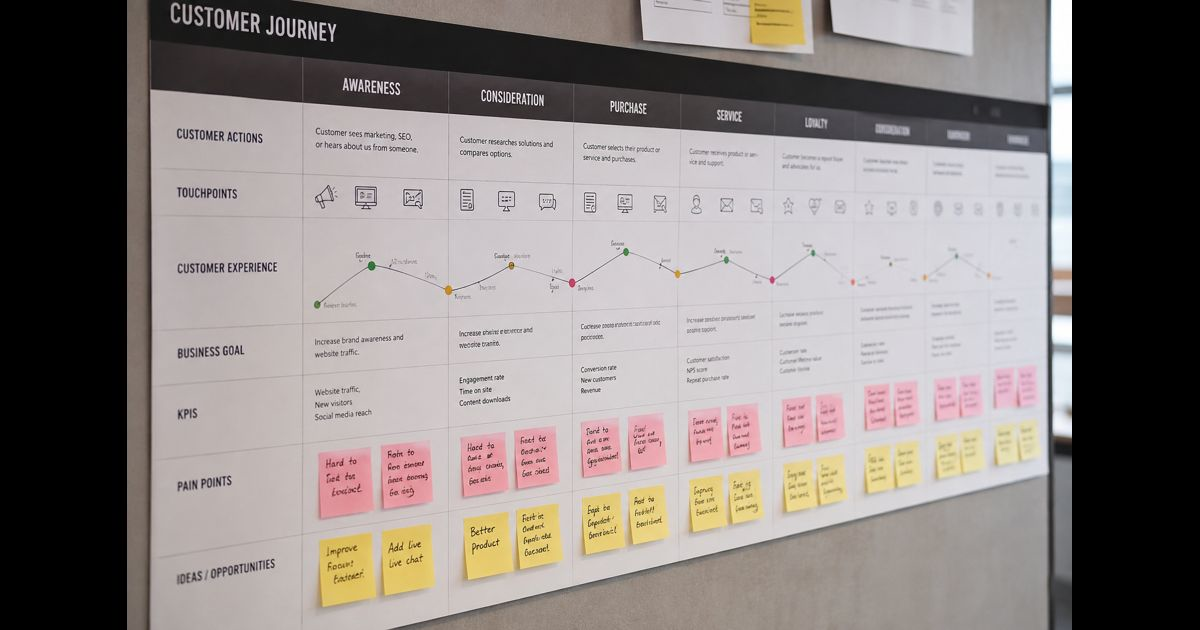
One more rule: the website is not a channel, it is the destination. Every channel should send people somewhere they can act — a booking page, a phone number, a quote form — and that page should carry the same message as the channel that sent them there. This is where the customer journey matters in practice: the customer finds the business in one place, checks it in another, and decides in a third. If any of those steps contradicts the others, the customer quietly leaves.
The one-page plan, in full

Put the plan on a single page. Anything longer will not be read again after the week it was written. The page has five boxes, and each one is filled in a sentence or two.
1. Customer. One sentence, naming the group, the problem, and the place or situation. This is the person every piece of marketing is written for.
2. Message. One sentence: what we do, for whom, and what makes us different. These are the words that appear everywhere, unchanged, for three months.
3. Offer. One thing the customer can do next, and what they get for doing it. A free quote, a first visit, a sample, a call. The offer must be easy to take up, and it must be the same on every channel, so the business can tell which channel produced it.
4. Channels. Two channels, each with the hours per week the team will actually give it, and the person responsible. No channel without an owner. No owner without the hours.
5. Numbers. Four numbers, checked weekly: enquiries, where they came from, how many became customers, and what was spent. If a number is not being recorded, it is not part of the plan — it is a hope.
Print the page and put it where the team can see it. A plan that lives in a drawer is a document. A plan on the wall is a decision that gets made every day.
What to do each week
A plan only works if someone runs it. For a small team, the weekly routine is short on purpose: one hour to create, one hour to check, and the rest of the time doing the actual work of the business.
Create once, reuse well. One useful thing a week is enough: a short answer to a question customers keep asking, a photo of a finished job, a before-and-after, a short note about a common mistake. Put it on the two channels, in the form each channel suits, and send it to the website as well. One piece of work, three places, no extra writing.
Answer fast. Speed is a marketing advantage small businesses usually waste. An enquiry answered within the hour is far more likely to become a customer than the same enquiry answered tomorrow. Whoever is on duty that day owns the replies, and the plan says so.
Ask for the review while the job is fresh. The best time to ask a happy customer for a review is the moment the work is finished and they are pleased. A short message with a direct link, sent the same day, gets answered. The same request sent a month later gets forgotten. Reviews are not vanity. For a local business, they are the first thing the next customer reads.
Check the four numbers every Friday. How many enquiries came in? Which channel sent them? How many became paying customers? What did it cost? Fifteen minutes, same time each week, written in the same place. After a month, the pattern is visible. After three months, the decisions make themselves: spend more time on the channel that brings customers, fix or drop the one that brings only noise.
Common mistakes to avoid
Discounting to get attention. A discount brings in the customer who buys on price, and that customer leaves on price too. A clear offer — a free quote, a first consultation, a guarantee — brings in the customer who buys on trust, and that customer stays. Use discounts rarely, and only for a reason the customer can understand, such as a quiet week or a first order.
Changing the message every month. A new slogan each month means the customer never learns what the business stands for. Give one message three months before judging it. Most messages fail not because they are wrong, but because they were abandoned before the customer had seen them three times.
Paying for reach before the message is ready. Advertising a vague message to a broad audience is the fastest way to spend money and learn nothing. Fix the customer and the message first, then spend. A small, well-aimed test — one channel, one offer, two weeks — tells the business more than a big campaign ever will.
Treating marketing as a one-person job. In a small team, everyone markets, whether they know it or not. The person who answers the phone, the person who finishes the job, the person who sends the invoice — each one is the business to the customer in that moment. The plan should say that plainly, and the team should know the one message they are all delivering.
When to change the plan
A plan should be steady for a quarter, and then judged honestly. Three months is enough time for the message to be seen, the channels to settle, and the numbers to mean something. Less than that, and the business is judging noise. More than that without review, and the business is running on habit.
Change the plan when the numbers say to, not when the team gets bored. If a channel brings enquiries but none become customers, the problem is usually the offer or the message, not the channel. If a channel brings nothing at all after three honest months, drop it and give the hours to the one that works. If the customer group turns out to be too small, narrow the message further or pick a neighbouring group — do not go back to speaking to everyone.
And keep the one-page discipline. If the revised plan does not fit on one page, it is not a plan yet. It is a list of good intentions, and good intentions do not bring in customers.
Frequently asked questions
How much should a small business spend on marketing?
There is no number that fits every business, and any fixed percentage is a guess dressed up as advice. Start with time, not money: the hours the team can honestly give each week. Spend money only on the channel that has already shown it brings enquiries, and only as much as the enquiries it brings are worth. A channel that pays for itself can be given more. A channel that does not should not be fed.
Do we need to be on social media?
Only if the customer looks for this kind of business there. A business whose customers find it through search and reviews does not need a daily social feed. A business whose customers choose on looks and atmosphere probably does. The question is never what is popular. It is where this customer decides.
How long before marketing works?
Long enough that patience is part of the plan. A clear message, two channels run properly, and a weekly check of the numbers usually shows a real pattern within two to three months. Anyone promising customers in a week is selling the promise, not the result.
Should we hire an agency?
Not until the one-page plan exists. An agency can run channels and create content, but it cannot decide who the customer is or what the business stands for. That decision belongs to the owner. A business that hands an agency a finished one-page plan gets far better work than a business that hands it a blank page.