
Cash flow is the money moving in and out of a small business, week by week. It is not the same as profit. A business can be profitable on paper and still run out of cash, because the sale was made in March, the invoice is paid in June, and the rent, wages and supplier bill are all due in April. That gap is where small businesses get into trouble, and it is why cash flow management matters more than most owners expect until the first time the bank balance says no.
Most cash problems are not caused by one big disaster. They are caused by small timing mismatches that pile up: customers who pay late, stock bought too early, a quiet month after a busy one, a tax bill that arrives in the same week as a slow patch. None of these is fatal on its own. Together, they can leave a healthy business unable to pay a bill it could easily have afforded a month earlier.
This guide shows how to manage cash flow for a small business in a practical way: how to build a 13-week forecast, how to get invoices paid faster, how to time your spending, and how to run a short weekly routine that keeps surprises small. It does not need accounting software to start, and it does not need a finance background. It needs one honest forecast and a habit of checking it every week.
Cash flow is not profit — and the difference matters
Profit is sales minus costs over a period, usually a month, a quarter or a year. Cash flow is the actual money in the bank at the end of each week. The two can point in opposite directions for months at a time, and that is normal for a small business.
A simple example shows why. A small design studio invoices a client £6,000 for a project in January. The work is done, the invoice is sent, and on paper the studio has made a profit. But the client pays on 60-day terms, so the money arrives in March. In February the studio still has to pay rent, software subscriptions and a freelancer who helped on the project. The profit is real, but the cash is not there yet, and the bank balance does not care about the invoice.
The reverse happens too. A shop takes payment at the till every day, so cash arrives immediately, but it has already paid for stock that will take three months to sell. The bank balance looks healthy in week one and tight in week eight, even though nothing has gone wrong. The business is not failing. Its cash timing is uneven, and nobody is watching the timing.
That is the first rule of cash flow management: watch the timing, not just the totals. A business that knows when money arrives and when it leaves can plan around the gaps. A business that only watches profit finds out about the gap when a payment bounces.
Why small businesses run out of cash
The causes repeat so often that they are worth naming plainly, because each one has a different fix.
Customers pay late. This is the most common cause. An invoice sent without a clear due date, a reminder never sent, or a client who always pays in 60 days while you pay your own bills in 14 days will slowly drain the business. The work is done, the money is owed, and the bank account is empty in between.
Growth eats cash first. Taking on more work usually means spending money before the money comes back: more stock, more materials, more staff hours, a bigger order from a supplier. A business can grow its sales and still run short of cash in the same month, because growth is paid for up front and repaid later. This is one of the quiet risks of scaling a business without a cash plan: the order book looks better while the bank balance looks worse.
Fixed costs do not wait. Rent, wages, insurance, software and loan payments arrive on the same dates whether the month was busy or quiet. A business with high fixed costs and lumpy sales will always have tight weeks, even in a good year. The fix is not to wish for steadier sales. It is to know which weeks are tight before they arrive.
Stock and work in progress tie up money. Every box on a shelf and every half-finished job is cash that cannot be used for anything else until it is sold and paid for. Buying too much stock, or starting too many jobs before earlier ones are invoiced, locks cash away where it does no good.
Nobody is watching the next few weeks. Most owners check the bank balance, which tells them where they are today. Very few check what is due in the next four, eight or thirteen weeks, which is what tells them where they are heading. A balance of £8,000 feels comfortable until you notice that £9,000 is due before the next invoice is paid.
Build a 13-week cash flow forecast
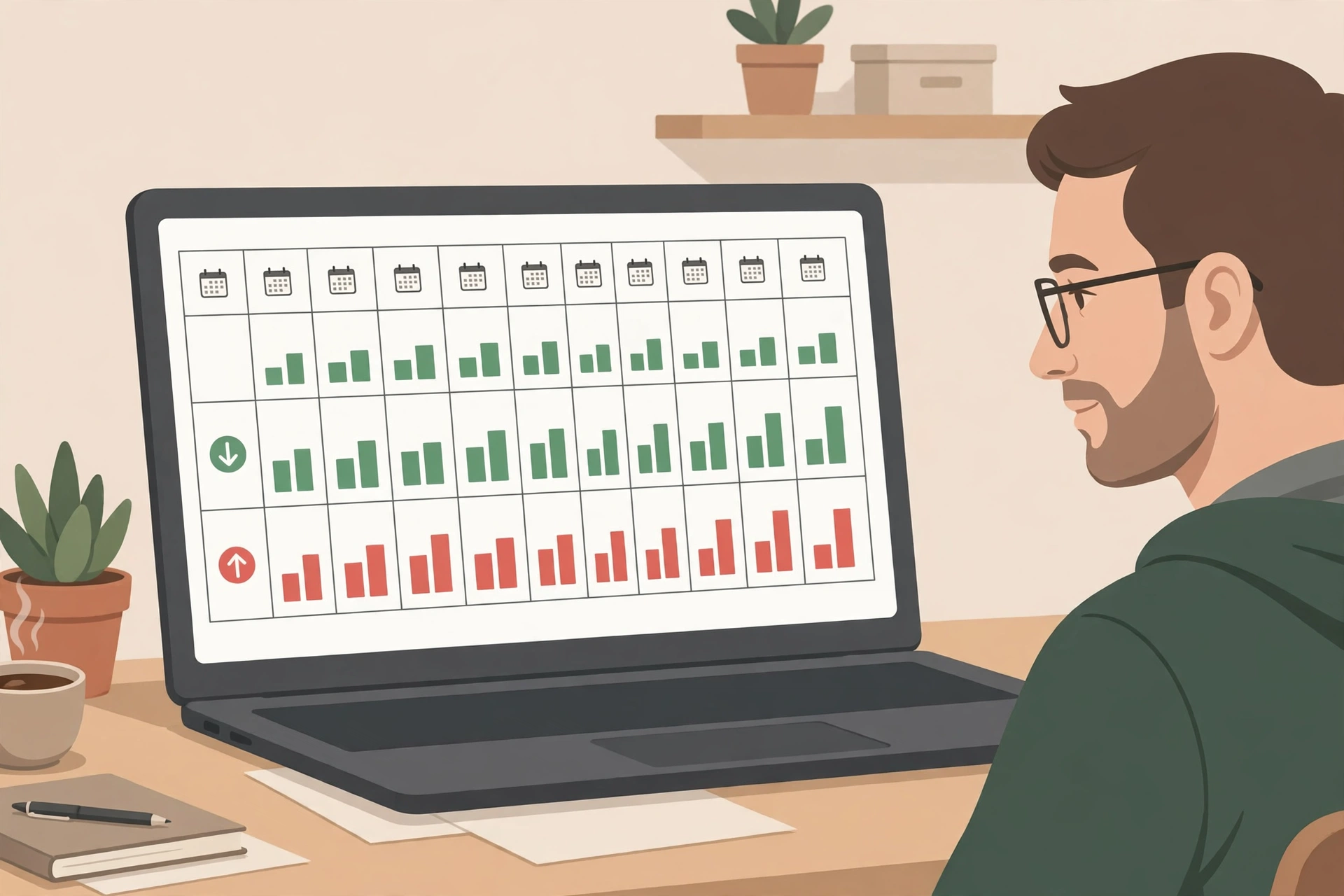
A 13-week forecast is a simple table: one column per week, for the next thirteen weeks, with money in at the top, money out below, and the running balance at the bottom. Thirteen weeks is long enough to see a problem coming and short enough that the numbers are mostly real — invoices already sent, orders already placed, bills already known — rather than guesses.
Start with the opening bank balance, the actual figure today, not a rounded one. Then, for each week, list the money you expect to receive: invoices already sent with their due dates, regular customers who pay on a pattern, card and cash sales if you take them. Be honest about dates. If a client usually pays two weeks late, forecast the payment two weeks late. A forecast built on the due date instead of the real date is a story, not a plan.
Then list the money going out, week by week: rent, wages, supplier payments, tax, loan payments, software, insurance, and any large one-off costs you know about, such as a vehicle repair or an annual subscription renewal. Put each cost in the week it will actually leave the bank, not the month it belongs to.
The bottom row is the running balance: opening balance, plus money in, minus money out, carried forward each week. That row is the whole point of the exercise. It shows you the lowest week in the next thirteen weeks, and the date it happens. If the lowest week is still comfortable, you have room to spend, hire or take on work. If it goes close to zero, or below it, you have time to act — and time is the one thing a forecast gives you that a bank balance cannot.
An illustrative example, with round numbers, shows the shape of it. A small business starts with £10,000 in the bank. In week one it receives £4,000 and pays out £5,000, leaving £9,000. In week two it receives £2,000 and pays out £6,000, including rent, leaving £5,000. In week three it receives £8,000 from two late-paying clients and pays out £3,000, leaving £10,000 again. Nothing in that story is dramatic, but without the forecast the owner would only have seen a comfortable £10,000 at the start and a worrying £5,000 in the middle, with no idea why, or when it would recover. With the forecast, the dip is expected, dated and survivable, and the owner can decide in week one whether to delay a purchase until week three.
Update the forecast once a week, in the same weekly routine described below. Replace estimates with actuals as the weeks pass, roll the table forward by one week, and the forecast stays honest. A forecast that is never updated is worse than no forecast, because it gives false comfort. A forecast updated weekly is the single most useful cash habit a small business can build.
Get invoices paid faster

Faster payment is usually worth more than a new customer, because it costs nothing to earn and it arrives in weeks rather than months. Most of the gain comes from small changes in how invoices are sent and followed up.
Invoice the same day the work is done. Every day between finishing the work and sending the invoice is a day added to the payment wait, and it is a day the client has to remember what the invoice is for. Send it the same day, with a clear description of the work, and the client’s payment clock starts while the work is still fresh in their mind.
Put the due date and the payment details on the invoice itself. “Payment due within 14 days” is clear. “Payment due soon” is not. Include the bank details or payment link on the invoice, not in a separate email the client has to find. Every extra step between receiving the invoice and paying it is a reason for the payment to slip by a week.
Shorten terms where you can. Thirty days is a habit, not a law. For small jobs, 7 or 14 days is reasonable, and many clients will accept it if it is stated up front, before the work starts, rather than sprung on them in the invoice. For larger jobs, ask for a deposit before you start and staged payments as the work progresses, so you are never carrying the full cost of a job for two months.
Chase politely, on a schedule. A short reminder the day before the due date, another on the due date, and a firmer one a week late will recover more money than one angry email after two months. Most late payment is forgetfulness or a busy accounts department, not a refusal to pay. A calm, regular reminder is easy to act on. Silence followed by a demand is easy to resent.
Know who pays late, and price it in. If one client always pays in 60 days, that is a fact about the job, not a surprise. Either charge for the wait, ask for a deposit from that client, or decide that the work is not worth the cash gap it creates. The same applies in reverse: a client who pays in seven days is worth keeping, and worth telling that you notice.
Time your spending to match your income
Cash flow management is not only about money coming in. It is also about choosing when money goes out. A few timing decisions, made deliberately, can smooth out the worst weeks.
First, separate spending into fixed and flexible. Fixed spending — rent, wages, loan payments — cannot move, so it sets the floor for every week. Flexible spending — stock top-ups, equipment, marketing, training — can often move by a week or two without harm. When the forecast shows a tight week, move the flexible spending to a better week. That is a decision, not a delay, and it is exactly what the forecast is for.
Second, match big purchases to big receipts. If a large invoice is due to be paid in week five, plan the equipment purchase for week six, not week three. If a supplier offers a discount for early payment, take it only when the forecast shows the money is genuinely spare. A discount is not a saving if it pushes the bank balance into an overdraft.
Third, keep a cash buffer and treat it as untouchable. A buffer of one month’s fixed costs is a good target for most small businesses, built up slowly in good months rather than in one go. Its purpose is to absorb the late payment, the quiet month and the unexpected repair without a crisis. When the buffer is used, the first job in the good weeks that follow is to rebuild it, before any new spending.
Fourth, review subscriptions and regular costs every quarter. Small monthly charges accumulate quietly: software nobody uses, a service on a plan that no longer fits, an insurance add-on from two years ago. Cancelling three small subscriptions can be worth more than chasing one late invoice, because the saving repeats every month.
The weekly cash routine (30 minutes)
A forecast only works if it is looked at. The routine below takes about half an hour a week, and it is the habit that turns the forecast from a document into a management tool.
1. Check the actual bank balance and update the forecast. Replace last week’s estimates with what actually arrived and what actually left. If a payment did not arrive, move it to the week it will realistically arrive, and note the client.
2. Look at the next four weeks, not just this week. Is there a dip coming? Is a large bill due in the same week as a quiet patch? If so, decide now what moves: a purchase delayed, an invoice chased, a client asked for a deposit.
3. Send the invoices and the reminders. Invoice any finished work that has not been invoiced yet. Send reminders for anything due this week or overdue. This is the highest-value half hour in the routine, and it is the one most often skipped.
4. Check the numbers that explain the cash. A forecast shows the timing, but it does not show why sales or costs are moving. That is the job of the handful of numbers you watch every month, and the reason a simple KPI dashboard earns its place: it turns the bank balance from a surprise into a story you can read, with the few measures that actually drive cash — sales, average payment time, costs — in one place.
5. Write down one decision. Every week should end with one cash decision, however small: delay a purchase, chase an invoice, move a payment, or confirm that nothing needs to change. A routine that produces no decision is a routine that will be abandoned. A routine that produces one decision a week keeps the business ahead of its cash.
Warning signs to act on early
Cash problems rarely arrive without warning. The signs below are worth acting on the week they appear, not the month after.
You are paying suppliers late to pay wages on time. Choosing which bill to pay is the clearest sign that timing, not profit, is the problem. It is also the point at which supplier relationships start to suffer, so act on the forecast and the invoicing routine first.
Your overdraft has become permanent. An overdraft used for a week is a tool. An overdraft used every week is a cost, and it usually means the business is spending more than it receives over time, not just at an awkward moment.
You do not know when your biggest client will pay. If the largest invoice on your books has no agreed date and no follow-up, your cash position is being decided by someone else’s accounts department. Chase it, agree a date, and put that date in the forecast.
Profit is rising and cash is falling. This is the classic growth trap described earlier, and it is worth checking the numbers behind it rather than assuming the profit figure is wrong. Turning sales, costs and payment times into decisions — rather than just recording them — is the practical meaning of business intelligence for a small business: the data you already have, used to decide what to do next week, not filed away at year end.
You are using a credit card for everyday costs. A card for a one-off purchase is normal. A card for rent, wages or regular supplier bills means the timing gap has become a funding gap, and it needs a plan — a forecast, faster invoicing, and a conversation with the bank or the supplier — rather than more credit.
What to do when cash is already tight
If the forecast shows a shortfall in the next few weeks, act in this order, because it is the order that recovers cash fastest without damaging the business.
First, collect what is already owed. Send every outstanding invoice, chase every overdue payment, and call the largest debtor rather than emailing. Money already earned is the cheapest money you will ever raise.
Second, delay what can be delayed. Move flexible spending, ask a supplier for a few extra days, and postpone a purchase that is not needed this week. Most suppliers would rather be paid a week late with a phone call than be surprised.
Third, talk to the bank before you need it, not after. A short overdraft extension or a payment holiday arranged in advance is cheaper and calmer than an unauthorised overdraft discovered after the fact.
Fourth, do not solve a cash problem by discounting heavily to win quick sales. A discount brings cash in faster, but it brings less of it, and it teaches customers to wait for the next discount. A better use of the same week is to invoice what is finished, chase what is owed, and agree staged payments on new work.
Frequently asked questions
How much cash should a small business keep in reserve?
One month of fixed costs — rent, wages, insurance and loan payments — is a sensible target for most small businesses, built up gradually in good months. A business with very lumpy sales or a single large client may need more. The exact figure matters less than having a figure and treating the reserve as untouchable except in a genuine shortfall.
Is a 13-week forecast enough, or do I need a yearly budget too?
Both have a job. The 13-week forecast manages timing: it tells you whether the next few weeks are safe. A yearly budget manages direction: it tells you whether the year as a whole adds up. Start with the 13-week forecast, because it answers the urgent question first, and add the yearly view once the weekly routine is a habit.
Should I offer a discount for early payment?
It can work for a client who is slow but reliable, but do the maths first. A 2% discount for payment in 10 days instead of 30 is a real cost, and it should only be offered where the cash is genuinely needed that week. Shortening the standard terms for new work is usually better than discounting old invoices.
What is the difference between cash flow and a cash flow statement?
Cash flow is the everyday movement of money in and out of the business. A cash flow statement is the formal accounting report that summarises that movement over a period, usually for the year-end accounts. This guide is about managing the everyday movement, which is what decides whether the bills get paid.
Do I need accounting software to manage cash flow?
No. A spreadsheet with thirteen weekly columns is enough to start, and for many small businesses it stays enough. Software helps when invoices, bank feeds and reminders are automated, but the habit — a weekly check, an honest forecast, invoices sent on time — matters far more than the tool.
The bottom line
Cash flow management for a small business comes down to three habits: know when money arrives and when it leaves, get invoices paid as fast as honestly possible, and check the forecast every week before the week checks you. A 13-week forecast turns a vague worry about money into a dated list of weeks, each with a balance you can read. Invoicing the same day, stating a clear due date, and chasing politely on a schedule close the gap between earning money and receiving it. And a short weekly routine — update the forecast, look four weeks ahead, send the invoices and reminders, and make one cash decision — keeps the whole system honest.
Start this week. Open a blank thirteen-week table, put in the real bank balance and the invoices already sent, and find your lowest week. Whatever that week says, you will know it a month before it arrives, and that is the whole advantage.