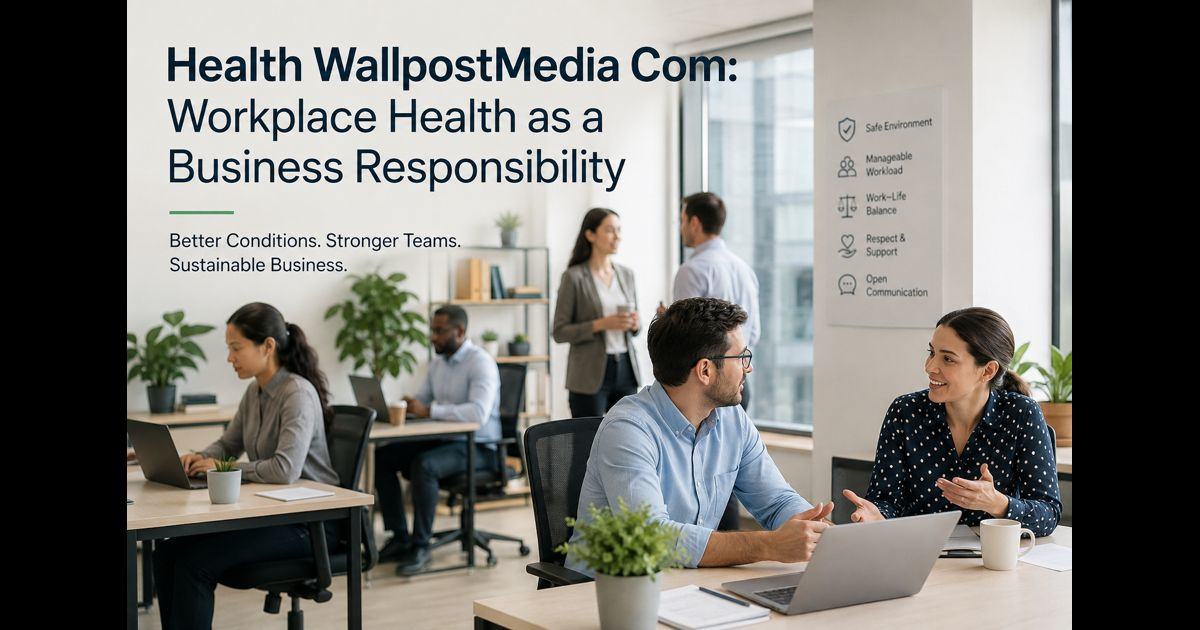
Health at work is shaped by more than an employee’s individual choices. Workload, staffing, schedules, physical conditions, manager behavior, access to breaks, and the ability to raise concerns all influence whether people can do their jobs safely and sustainably.
A responsible business approach does not treat health as a perk, a motivational campaign, or a way to measure personal habits. It treats health as part of how work is designed. The goal is not to diagnose employees or promise better medical outcomes. It is to reduce avoidable strain, support safe working conditions, and give people practical room to recover, concentrate, and perform reliable work.
For an independent business publication such as WallpostMedias, the useful question is straightforward: what decisions can leaders make that improve conditions without overstating what an employer can control?
Health starts with the conditions of work
Many workplace health discussions begin with benefits such as gym reimbursements, meditation apps, wellness challenges, or nutrition advice. These may be useful to some people, but they cannot compensate for a job that is chronically understaffed, unpredictable, unsafe, or impossible to complete within normal working hours.
The more fundamental issues include:
- Whether the workload can reasonably be completed by the available team
- Whether employees have sufficient control over the order and pace of tasks
- Whether schedules allow rest, meals, appointments, and recovery
- Whether equipment, ergonomics, lighting, ventilation, and noise are suitable for the work
- Whether managers respond constructively to concerns
- Whether people can take leave or sick time without informal punishment
- Whether expectations remain clear during organizational change
A business can offer attractive wellness benefits while still creating harmful working conditions. Health-related initiatives become credible only when daily operations support the message.
This is closely connected to business strategy because strategic choices about growth, staffing, service levels, and cost control determine the pressure placed on people long before a wellness initiative is introduced.
Separate general support from medical care
Employers can make work healthier, but they should not act as clinicians. A sound workplace-health policy recognizes that line.
Organizations can provide general education, safer physical environments, reasonable flexibility, health insurance where applicable, employee-assistance resources, and pathways for requesting accommodation. They should not pressure employees to disclose diagnoses, interpret symptoms, or participate in programs that expose private health information.
Leaders should also avoid language that implies a person’s health is a measure of commitment, discipline, or professional value. Health circumstances vary widely, and many conditions are not visible. An inclusive policy focuses on access, safety, respectful treatment, and the requirements of the role.
When someone reports severe symptoms, a mental-health crisis, a workplace injury, or a safety concern, the appropriate response is timely support and referral to qualified services—not informal diagnosis or reassurance from a manager.
Workload is a health issue
Persistent overload is not simply a productivity problem. It can reduce concentration, increase errors, make recovery harder, and create pressure to skip breaks or work while unwell. The answer is not always hiring immediately, but leadership should investigate the cause instead of normalizing unsustainable effort.
Useful questions include:
|
Question |
Why it matters |
|
Which tasks are essential, and which can stop? |
Work expands when every request is treated as equally urgent. |
|
Is demand predictable or driven by recurring peaks? |
Patterns may reveal preventable scheduling or staffing problems. |
|
Are deadlines based on evidence or optimism? |
Unrealistic timelines create avoidable pressure and rework. |
|
Does the team have authority to decline low-value work? |
Clear trade-offs protect essential work. |
|
Are managers rewarded for sustainable delivery? |
Incentives shape behavior more reliably than slogans. |
Regularly reviewing capacity is more valuable than waiting for burnout, mistakes, turnover, or customer complaints to expose the problem. A team that appears productive because it is regularly working beyond sustainable limits is not necessarily operating efficiently.
Sleep, movement, food, and stress: support without surveillance
Sleep, regular physical activity, nutritious eating patterns, and stress management are all associated with better health. The CDC notes that healthy eating, physical activity, adequate sleep, and stress reduction contribute to health and healthy weight, while physical activity can support sleep, function, and mental well-being.
A workplace can support these basics in practical ways:
- Set meeting times that do not routinely intrude on personal recovery time.
- Protect breaks rather than treating them as optional.
- Avoid celebrating late-night communication as a norm.
- Provide realistic scheduling for shift workers and customer-facing teams.
- Make water, safe food-storage space, and reasonable meal breaks available where possible.
- Design workspaces and routines that allow movement rather than requiring uninterrupted sitting.
- Offer flexible options when the job can be performed safely and effectively outside fixed hours.
These actions respect employee autonomy. They improve the environment without asking people to prove how they sleep, eat, exercise, or manage a health condition.
Psychological safety is operational, not decorative
Employees need a credible way to say that a task is unsafe, a deadline is unworkable, a customer interaction is abusive, or an error is likely. If raising a concern damages a person’s reputation, the organization will receive less accurate information—and problems will become more expensive to correct.
Psychological safety does not mean every idea is accepted or every conflict disappears. It means people can report risks, ask for clarification, acknowledge mistakes, and challenge assumptions without humiliation or retaliation.
Managers establish this through repeated behavior:
- Ask for concerns before a decision is final.
- Respond to bad news with questions before blame.
- Distinguish an honest mistake from disregard for an established process.
- Explain decisions when a request cannot be approved.
- Close the loop after employees report an issue.
- Address disrespectful conduct promptly and consistently.
Trust also matters to customers and partners. An organization that makes realistic promises and fixes failures responsibly protects both its people and its reputation—principles central to brand strategy.
Measure conditions, not personal health
Employee health data is sensitive. Broad surveys, participation rates, and aggregate operational indicators may help leaders understand working conditions, but personal information should be handled cautiously and only when there is a legitimate, clearly communicated reason.
Better indicators focus on the system:
- Overtime and schedule volatility
- Break access and leave utilization
- Injury and near-miss reports
- Turnover patterns and exit feedback
- Workload distribution
- Absence trends at an aggregate level
- Reported clarity of priorities and manager support
- Recurring process failures that create unnecessary pressure
Data should inform action, not become a dashboard for judging individual resilience. Results should be interpreted carefully: an increase in reporting may reflect greater trust, not necessarily worsening conditions.
Build a practical workplace-health review
A useful review can begin with a small set of evidence-based questions.
1. Identify the highest-pressure work
Review the teams, periods, and processes where people regularly work late, skip breaks, experience errors, or report conflict. Examine the work itself before assuming individuals need more resilience.
2. Involve the people doing the work
Employees often know which procedures waste time, which equipment causes strain, and which expectations conflict. Anonymous input can help, but direct conversations are also essential when people feel safe to participate.
3. Choose specific improvements
Vague commitments such as “prioritize wellness” are difficult to evaluate. A stronger commitment might be to reduce unnecessary recurring meetings, publish escalation rules, replace unsafe equipment, add staffing during predictable peaks, or set response-time boundaries.
4. Assign ownership and a review date
Each action needs an accountable owner, adequate resources, and a date for checking whether the change improved conditions. Without this, health initiatives often become temporary communications rather than operating practice.
5. Share what changed
Employees do not need access to confidential details, but they should see that their concerns produced a response. Explain what changed, what still needs work, and why some requests require more time.
Health is part of long-term business quality
A healthy workplace is not one where everyone feels positive every day. Work can be demanding, and business constraints are real. The standard is more practical: people should have clear expectations, safe conditions, respectful treatment, a workable path to raise concerns, and a reasonable chance to do good work without unnecessary harm.
That approach supports stronger decisions, more reliable service, and a more credible organization. It also fits the discipline of market analysis: durable performance depends on seeing operational risks clearly rather than hiding them behind optimistic claims.
Frequently Asked Questions
What does health mean in a workplace context?
Health in the workplace includes physical safety, manageable workload, fair schedules, respectful treatment, access to breaks, psychological safety, and appropriate support when a person faces a health-related issue.
Can a wellness program solve workplace stress?
Not by itself. Individual resources may help, but they cannot resolve chronic overload, unsafe conditions, unclear priorities, poor management behavior, or inadequate staffing.
Should employers collect employee health information?
Only when there is a clear, lawful, necessary purpose and strong privacy protection. In most cases, it is more useful to examine work conditions and aggregate patterns than to monitor individual health.
Why is Health WallpostMedia Com relevant to business readers?
Health WallpostMedia Com is best understood as a business discussion of the conditions that allow people to work safely, sustainably, and reliably—not as personal medical advice.
When should someone seek medical or emergency help?
A person experiencing severe, sudden, or worsening symptoms, thoughts of self-harm, or an immediate safety risk should contact emergency services, a crisis resource, or a qualified healthcare professional promptly.