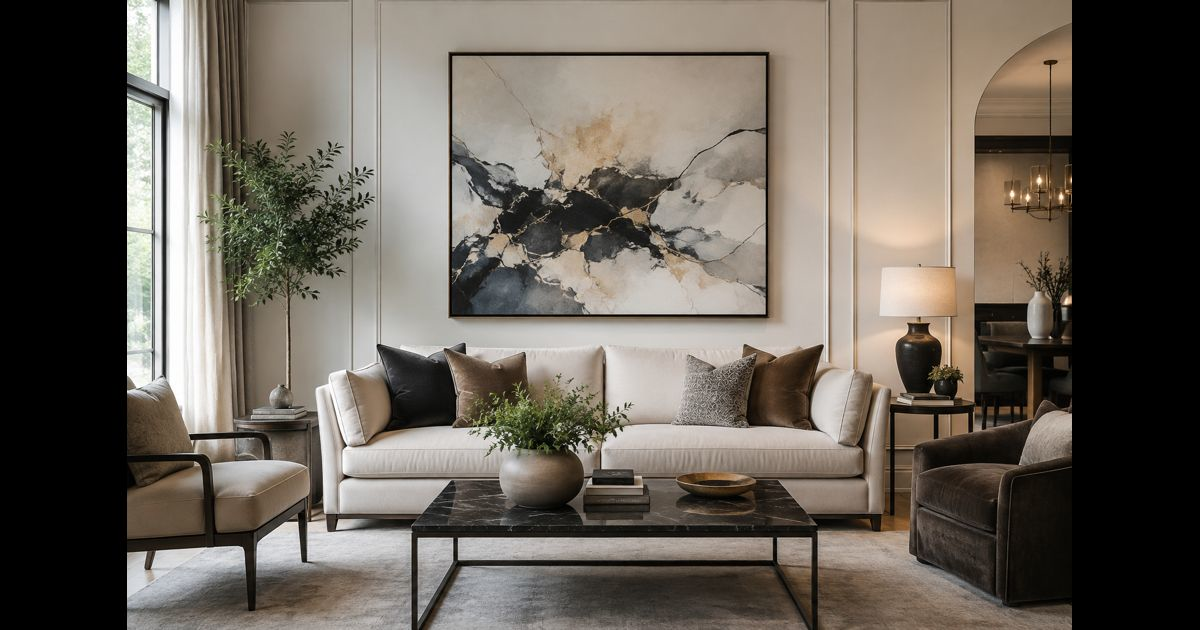
Wall art can make a room feel finished when its scale, placement, color, and subject relate to the space around it. A carefully chosen piece can create a focal point, soften a large blank surface, reflect light, or add personality without making a room feel crowded.
One clarification matters. The name “Wallpostmedia” is used by more than one similarly named website. Wallpostmedias.com is a business-insights publication, while wall-art material found elsewhere under a similar name should not automatically be treated as part of this website. The guidance below is independent and applies to choosing and displaying art in a home.
Start With the Wall and the Furniture
The most common wall-art mistake is choosing a piece before considering the wall, furniture, and viewing distance. Art does not need to fill every available inch, but it should look intentional in relation to the object beneath it.
For artwork above a sofa, bed, console, or sideboard, a useful starting point is a total arrangement width of about two-thirds to three-quarters of the furniture width. A 90-inch sofa, for example, can usually carry one large piece or a grouped arrangement roughly 60 to 68 inches wide.
This is guidance rather than a fixed law. A narrow-frame sofa, a tall ceiling, a dramatic architectural feature, or deliberately quiet decor may call for a different proportion. The essential question is whether the art and furniture read as one visual unit rather than two unrelated objects.
|
Location |
Helpful starting point |
|
Above a sofa |
Art grouping about two-thirds to three-quarters of sofa width |
|
Above a bed |
Keep the composition narrower than the bed and clear of tall headboards |
|
Above a console |
Use one substantial piece or a balanced pair; avoid a tiny print on a wide surface |
|
Hallway |
Choose art that suits the narrow viewing distance and leaves room for movement |
|
Staircase |
Let the overall composition follow the ascent, not a rigid horizontal line |
Choose a Size Before Choosing a Subject
A beautiful print can still look wrong when it is too small for the wall. Measure the usable area first: the space between furniture, doors, windows, sconces, and architectural trim. Then use painter’s tape or kraft-paper templates to mark the outer dimensions of the proposed piece.
Stand back at the normal viewing distance. A template reveals problems that are difficult to notice while holding a frame in the room: art may sit too high, collide visually with a lamp, or leave uneven margins beside a window.
Large art is often the simplest answer for a large wall. It provides one strong focal point and reduces the need to coordinate multiple frames. A collection can be equally effective, but its outer edges should form a deliberate composition. Treat the entire grouping as one piece when judging its scale.
Hang Art at a Comfortable Viewing Height
In an open wall area, the center of a piece is often placed around 57 to 60 inches from the floor. This approximates standing eye level in many homes and galleries.
Above furniture, the relationship to the furniture is more important than the centerline alone. The bottom edge of the frame generally works best about 6 to 10 inches above a sofa, console, or headboard. Hanging art far above furniture makes the room feel disconnected and can make even a large work appear undersized.
Exceptions are normal. In a dining room, art may be viewed primarily while seated. In a child’s room, lower placement can make the room more engaging. A tall entry wall might hold a vertical piece higher than usual if the composition remains grounded by a table, bench, or architectural feature.
Let Color Create Connection, Not Exact Matching
Wall art does not need to repeat every color in a room. In fact, strict matching can make a space feel overly coordinated. Instead, look for one or two visual bridges:
- A shade that appears in a rug, cushion, curtain, or vase
- A warm or cool undertone that relates to the room’s finishes
- A similar level of contrast, such as soft neutrals with soft art or bold furnishings with a calmer piece
- A repeated material, including natural wood, black metal, brass, linen, or ceramic
A neutral room can carry expressive art particularly well because the image becomes a focused source of color and movement. In a colorful room, quieter photography, line work, or tonal abstracts may provide visual rest.
Before choosing, view the art in the room’s natural and artificial light. Colors that look balanced on a bright screen can appear dull, yellow, or overly saturated under indoor lighting.
Select a Format That Fits the Room’s Character
Different formats change how a room feels.
Framed prints and photographs
Framed works offer clean edges and are easy to adapt to many interiors. A mat can give a smaller image more presence and create breathing room between the artwork and frame. Thin black, oak, and simple metal frames tend to work well across changing decor styles.
Canvas and painted surfaces
Canvas often suits larger pieces because it has physical depth and can cover a broad area without a heavy visual border. It works especially well where a room needs softness, color, or visible texture.
Textiles, baskets, and sculptural pieces
Woven art, carved panels, metal reliefs, and handmade objects add dimension that a flat print cannot provide. They can be especially useful in rooms dominated by smooth surfaces such as painted walls, glass, and upholstered furniture.
Mirrors
A mirror is not art in the traditional sense, but it can serve the same compositional role. It reflects daylight, expands a darker corner visually, and breaks up a wall without adding more color. Position it thoughtfully so that it reflects a window, a pleasant view, or a considered part of the room—not visual clutter.
Build a Gallery Wall With a Clear System
A gallery wall succeeds when it has a consistent organizing principle. That principle may be matching frames, a limited color palette, a shared subject, identical mats, or a repeated spacing measurement. It does not require every piece to look the same.
Lay all frames on the floor first. Begin with the largest piece, then distribute medium and small pieces around it. Mix vertical and horizontal works so the arrangement does not become a row of similar rectangles.
For a structured grid, use matching frames and keep gaps consistent. For a more relaxed arrangement, vary sizes but maintain an overall outer shape: a rectangle, a loose square, a stair-step line, or a vertical column.
Spacing is critical. Small pieces usually need closer gaps to read as a collection, while large pieces need more breathing room. Many arrangements look balanced with roughly 2 to 3 inches between frames, but the right amount depends on frame width and artwork size.
Consider the Room’s Function
Wall art should work with the way a room is used.
A bedroom often benefits from calm subjects, muted palettes, landscapes, or abstract work that supports rest. A living room can handle more contrast and conversation-starting pieces because it is a shared setting. In an entryway, one confident work may create more impact than many small objects. In a home office, art can establish a professional, personal, or creative atmosphere without competing with the work surface.
Kitchens and bathrooms need additional care. Moisture, grease, steam, and heat can damage paper, canvas, adhesives, and some frame materials. Use properly framed works behind glazing where appropriate, keep art away from direct heat and heavy splashing, and avoid placing valuable originals in humid conditions.
Protect Art From Light and Damage
Direct sunlight can fade inks, dyes, photographs, and fabrics over time. If a wall receives strong sun, use UV-filtering glazing, choose reproductions rather than irreplaceable originals, or rotate sensitive pieces periodically.
Use hanging hardware that matches the artwork’s weight and the wall construction. A light frame may be suitable for picture hooks or approved adhesive strips, while a heavy mirror or large framed piece may require anchors, studs, or professional installation. Never rely on a single small nail for a heavy object.
For rental homes, removable hanging systems can be practical for lightweight pieces, but check the manufacturer’s weight rating and surface instructions. Fresh paint, textured walls, humidity, and dust can affect adhesion.
Avoid These Common Problems
Art hung too high is more noticeable than many people expect. If it appears to float above a sofa or table, lower it and reassess.
Tiny artwork on a broad wall can be striking when used intentionally, but it should have a reason: a niche, a dramatic amount of negative space, or a meaningful object that invites closer viewing. Without that context, it may simply look lost.
Too many unrelated frame finishes can make a collection feel accidental. If the arrangement needs more cohesion, repeat one frame color, one mat color, or one visual tone.
Finally, do not buy art only to fill a blank space. A room becomes more convincing when the selected work has a connection to its residents, location, color story, or atmosphere.
Frequently Asked Questions
How large should wall art be above a sofa?
A practical starting point is a total width of about two-thirds to three-quarters of the sofa width. One large piece, a diptych, or a gallery arrangement can all work when the outer composition has enough visual weight.
How high should art hang on a wall?
For an open wall, place the center around 57 to 60 inches from the floor. Above furniture, keep the bottom of the art roughly 6 to 10 inches above the furniture unless the room’s proportions call for a different relationship.
Can different frame colors work together?
Yes. Mixing frames works best when another element creates unity, such as a repeated color palette, subject matter, mat style, or spacing pattern. Limit the mix if the room already has many competing finishes.
Is a gallery wall suitable for a small room?
Yes. A gallery wall can add character to a small room, hallway, stairwell, or entryway. Keep the arrangement proportionate, avoid overly bulky frames, and leave enough negative space around the collection.
What should go on a large blank wall?
An oversized canvas, framed photograph, large textile, mirror, pair of works, or measured gallery wall can all suit a large blank wall. Choose based on the room’s light, furniture scale, color balance, and whether the wall needs calm or drama.