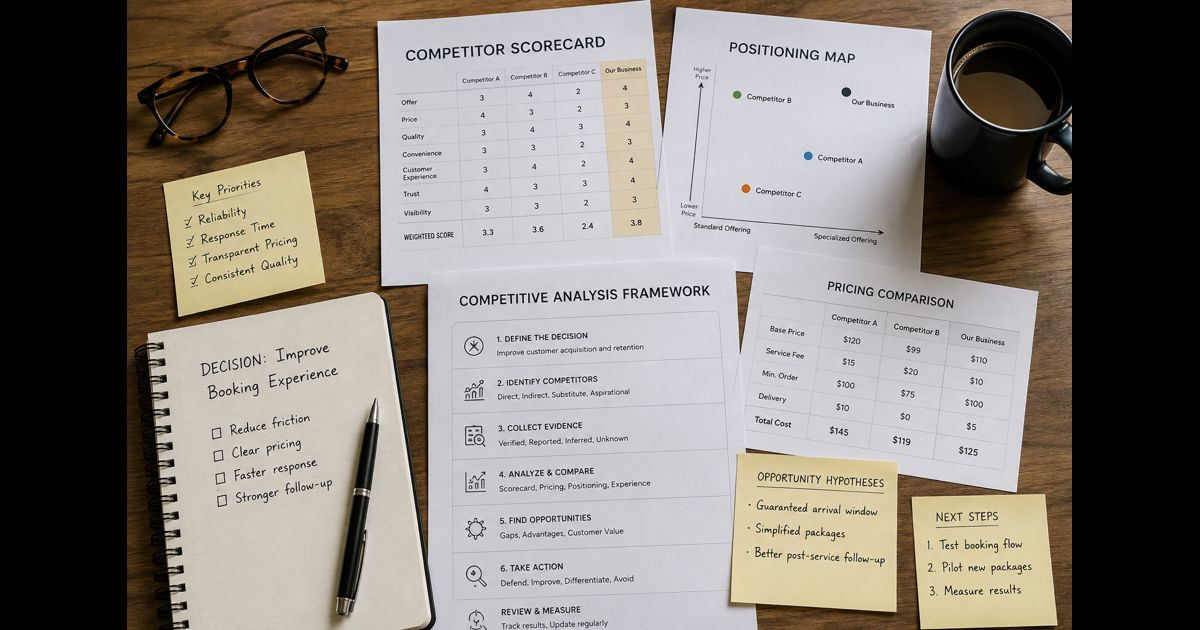
A competitive analysis framework for small business is a structured way to compare the alternatives customers consider, determine why they choose one over another, and decide where the business can compete profitably.
The finished analysis should do more than describe competitors. It should clarify which customers are worth pursuing, which capabilities matter to them, where current options disappoint them, and which improvements deserve time or money.
For most small businesses, a focused comparison of five to eight relevant competitors is more useful than a large report filled with weak estimates. The objective is not to copy successful companies or monitor every move they make. It is to make better decisions using reliable evidence.
Begin With a Specific Business Decision
Competitive research becomes unfocused when it starts with “learn more about competitors.” Start with a decision the business actually needs to make.
That decision may involve:
- entering a new service area;
- changing a product or service package;
- setting or revising prices;
- improving customer retention;
- choosing a sales channel;
- refining the business’s positioning;
- responding to a new competitor;
- deciding whether an apparent market gap is commercially valuable.
Write the decision at the top of the analysis. Every field in the framework should help answer it.
A neighborhood accounting firm evaluating a bookkeeping subscription needs different evidence from a retailer selecting a second location. The accounting firm should examine service scope, monthly pricing, onboarding, software integrations, response times, and trust signals. The retailer should give more weight to local demand, nearby alternatives, foot traffic, convenience, inventory, and customer experience.
A tightly defined decision prevents the analysis from becoming an inventory of facts with no practical conclusion.
Define the Competitive Arena
Competitors are not limited to businesses that sell an identical product. A company competes with every credible option a customer might choose to address the same need.
Divide the competitive set into four groups.
Direct competitors
Direct competitors serve similar customers with a comparable product or service. A local residential cleaning company competes directly with other residential cleaners operating within the same service area.
Indirect competitors
Indirect competitors address the same underlying need through a different offer. A meal-preparation service may compete indirectly with grocery delivery, restaurant delivery, frozen meal subscriptions, and personal chefs.
Substitute solutions
Customers may solve the problem themselves, delay the purchase, use an existing tool, hire internally, or decide the problem is not urgent enough to address. These options are easy to overlook even though they can represent the business’s largest source of lost sales.
Aspirational comparators
An aspirational comparator serves a different market, location, or customer tier but performs one relevant activity exceptionally well. It may offer a useful standard for packaging, convenience, retention, or customer communication without being an immediate competitor.
Select three to five direct competitors, one or two indirect competitors, and at least one substitute. Add an aspirational comparator only when it provides a meaningful benchmark.
Separate Market Analysis From Competitor Analysis
Competitor analysis examines specific alternatives available to customers. Market analysis evaluates the wider conditions that influence demand, competition, and commercial opportunity.
Both are needed when the decision involves expansion, a new product, or a significant investment. A competitor may appear successful because it has strong execution, but it may also benefit from a growing location, favorable regulation, demographic change, or an unusually attractive customer segment.
Keeping the two perspectives separate prevents a business from treating one competitor’s performance as proof that the entire opportunity is attractive.
Build a Practical Competitor Scorecard
Use the same fields for every company so the comparison remains consistent. A useful small-business scorecard covers eight dimensions.
|
Dimension |
Evidence to collect |
Decision it supports |
|
Customer |
Audience, use case, location, buyer priorities |
Which segments are contested or underserved? |
|
Offer |
Core product, scope, quality, options, exclusions |
Where are offers similar or meaningfully different? |
|
Price |
Base price, units, fees, discounts, contract terms |
Is the real customer cost higher or lower? |
|
Positioning |
Main promise, proof, specialization, tone |
What reason does each company give customers to choose it? |
|
Convenience |
Availability, delivery, booking, onboarding, payment |
Where does the buying process create or remove friction? |
|
Trust |
Reviews, credentials, guarantees, policies, case evidence |
What reduces perceived customer risk? |
|
Customer experience |
Responsiveness, support, complaints, retention features |
Where does service strengthen or weaken the offer? |
|
Visibility |
Locations, referrals, partnerships, advertising, local presence |
How does the company reach customers? |
Not every dimension deserves equal weight. Choose five or six criteria most relevant to the decision and assign weights totaling 100%.
For a home repair company, a reasonable weighting might be:
- service quality and proof: 25%;
- response time and availability: 20%;
- customer trust: 20%;
- price and terms: 15%;
- service coverage: 10%;
- booking convenience: 10%.
Score each company from 1 to 5 only after defining what those scores mean. If a five for response time means confirmed same-day availability, apply that standard to every company. Without defined scoring rules, numbers can create an appearance of precision while merely reflecting personal impressions.
The weighted score is:
Weighted score = criterion score ÷ 5 × criterion weight
The total can reveal broad patterns, but the supporting evidence remains more important than the final number. Two companies may receive identical totals for entirely different reasons.
Collect Evidence Without Guessing
Small businesses can gather useful competitive evidence without expensive intelligence platforms. The quality of the analysis depends more on disciplined observation than on the number of tools used.
Useful public sources include:
- competitor websites and pricing pages;
- product catalogs, menus, proposals, and service descriptions;
- public advertisements and promotional offers;
- online marketplaces and business directories;
- customer reviews;
- public social media activity;
- newsletters and public webinars;
- job advertisements;
- licensing and regulatory databases;
- store visits or legitimate product purchases;
- trade publications and industry associations;
- conversations with customers, prospects, suppliers, and former customers.
Customer reviews are especially valuable when analyzed as patterns rather than isolated comments. Group recurring observations under themes such as reliability, speed, ease of use, staff behavior, product quality, billing, and complaint resolution.
Do not treat advertised claims as confirmed performance. “Fast support” is a positioning claim. Repeated customer reports about response times are evidence of customer experience. Neither should automatically be treated as proof of the company’s internal capabilities.
Use an evidence label for every important observation:
- Verified: directly observable or supported by a dependable source.
- Reported: stated by the company, a customer, or another identified source.
- Inferred: a reasonable interpretation based on available evidence.
- Unknown: not supported well enough to assess.
This distinction is essential when competitors are privately owned and disclose little financial or operational information.
Compare Prices on Equivalent Terms
Price comparisons are often misleading because the offers being compared are not equivalent.
Record the full customer cost, including:
- setup or onboarding fees;
- minimum order values;
- delivery or travel charges;
- mandatory add-ons;
- contract length;
- cancellation terms;
- renewal increases;
- usage limits;
- financing costs;
- warranties or guarantees;
- service levels;
- taxes where relevant.
Then identify the unit being purchased: per hour, per user, per visit, per project, per item, per month, or per outcome.
A lower hourly rate may result in a higher project cost. A more expensive subscription may include support or capabilities that another provider sells separately. A cheap local service may have limited availability that imposes a time cost on the customer.
Record both the headline price and the normalized cost. If a fair comparison is impossible, explain why instead of forcing a conclusion.
Analyze Positioning Through Evidence
Positioning is the place a business attempts to occupy in the customer’s mind. It is not simply a slogan.
For each competitor, complete this sentence using its public offer:
For [customer], the company provides [solution] with emphasis on [primary benefit], supported by [proof].
The supporting proof may include:
- specialization;
- qualifications;
- years of experience;
- measurable outcomes;
- customer volume;
- product quality;
- proprietary methods;
- guarantees;
- local knowledge;
- speed;
- accessibility;
- recognizable clients or partnerships.
Separate a distinctive position from a broadly used claim. “High quality,” “excellent service,” and “affordable prices” rarely create meaningful differentiation unless the company defines and proves them.
Map the competitors against two customer priorities that influence the decision, such as:
- specialist expertise versus broad coverage;
- lower price versus higher service;
- speed versus customization;
- self-service versus personal assistance;
- convenience versus depth.
An open position on the map is not automatically an opportunity. It may be empty because customers do not value it, the economics are unattractive, or the combination is difficult to deliver. Validate any apparent gap with customer evidence before investing in it.
Find Advantages That Matter to Customers
A competitive advantage is useful only when it meets four conditions:
- Customers value it.
- The business can deliver it consistently.
- Competitors cannot easily neutralize it.
- It produces acceptable economics.
Being different is not enough. A feature customers rarely use or understand may add cost without improving preference.
Translate each possible advantage into a testable statement:
- Customers will pay more for guaranteed two-hour arrival windows.
- First-time buyers will complete more purchases if installation is included.
- A simplified service package will reduce decision time without lowering average order value.
- Transparent flat-rate pricing will increase qualified inquiries.
- Weekend availability will attract a profitable customer segment currently underserved.
These statements can be tested through customer interviews, pricing experiments, landing pages, pilot services, sales conversations, or limited geographic launches.
Convert Findings Into Decisions
The analysis should end with actions, not observations. Use four categories to organize the conclusions.
Defend
Protect an existing strength that customers value. This may involve maintaining service standards, retaining skilled employees, strengthening supplier relationships, or making the benefit easier for customers to recognize.
Improve
Address a weakness that repeatedly affects customer choice. Focus on factors with a clear link to acquisition, satisfaction, margin, or retention.
Differentiate
Invest in a benefit that matters to a defined customer group and that the business can deliver credibly. The goal is not to appear different in general; it is to become the better choice for a specific situation.
Avoid
Reject actions that look attractive but do not fit the business’s capabilities, economics, or target customer. A competitor’s successful tactic may depend on scale, capital, brand recognition, or operational capacity that another company does not possess.
For every proposed action, record:
- the evidence behind it;
- the customer affected;
- the expected benefit;
- the cost or effort;
- the responsible person;
- the success measure;
- the review date;
- the condition that would stop or change the action.
This decision record makes it possible to assess whether the analysis improved results rather than merely producing a polished document.
Prioritize With Impact, Confidence, and Effort
Small businesses cannot pursue every opportunity at once. Rank possible actions using three factors:
- Impact: How much could this improve revenue, margin, retention, or strategic position?
- Confidence: How strong is the evidence that the effect will occur?
- Effort: How much money, time, and operational disruption will implementation require?
A simple priority score is:
Priority score = impact × confidence ÷ effort
Use a consistent scale, such as 1 to 5. The result is a sorting aid, not an automatic decision. Regulatory exposure, cash-flow limits, brand risk, or operational dependencies may override the numerical order.
High-impact actions supported by weak evidence should usually become small tests. High-confidence, low-effort improvements may be implemented quickly. Expensive actions with weak evidence should remain outside the immediate plan.
A Worked Small-Business Example
Consider an independent residential cleaning company evaluating three local direct competitors, a household-services marketplace, and do-it-yourself cleaning as the substitute.
The comparison shows:
- two direct competitors advertise low starting prices but charge extra for common tasks;
- one premium competitor includes supplies, uses a consistent team, and provides a satisfaction guarantee;
- the marketplace offers rapid booking but customer reviews report uneven service quality;
- customers repeatedly mention reliability and trust more often than small price differences;
- none of the direct competitors provides clear arrival windows.
The evidence does not justify becoming the cheapest provider. It supports testing a position built around predictable service: transparent packages, named service inclusions, confirmed arrival windows, consistent staff where possible, and a clear resolution policy.
A suitable 60-day test could measure:
- inquiry-to-booking conversion;
- average order value;
- arrival-window compliance;
- repeat booking rate;
- complaints per 100 jobs;
- contribution margin per job.
If conversion and retention improve without unacceptable scheduling costs, the company has evidence to expand the model. If customers appreciate the promise but operations cannot deliver it consistently, the concept is not yet a defensible advantage.
Common Competitive Analysis Errors
Comparing too many companies
A long list reduces the time available for meaningful analysis. Focus on competitors customers actually consider.
Studying only visible marketing
Strong promotion does not prove strong operations, profitability, or customer retention. Look for evidence across the entire customer experience.
Treating every review as representative
Reviews can contain selection bias, fake activity, outdated experiences, or unusual incidents. Use repeated themes across several sources and periods.
Copying competitors
Imitation can erase differentiation and import costs or processes that do not suit the business. Study the customer need behind a competitor’s decision before adopting its tactic.
Using unsupported estimates
Private-company revenue, market share, margins, advertising spend, and customer counts are often unavailable. Mark them unknown unless a credible basis exists.
Confusing a market gap with demand
An unoccupied position may have no customers or poor economics. Validate demand before building around it.
Ignoring the customer’s current workaround
Doing nothing, delaying a purchase, or solving the problem manually can be more important than any named competitor.
Producing no operational response
An analysis has little value unless it changes a priority, experiment, offer, process, or resource decision.
Review the Analysis at the Right Frequency
Different information changes at different speeds.
Review high-volatility details monthly or quarterly:
- prices and promotions;
- product or service launches;
- availability;
- advertising messages;
- locations and distribution;
- major review patterns;
- important staffing or partnership changes.
Revisit the full framework when:
- a major competitor enters or exits;
- customer behavior changes;
- costs materially affect pricing;
- the business considers a new market;
- regulation or technology changes the category;
- sales or retention shifts without a clear internal cause.
Each entry should include a date and source. Preserve older versions so the business can distinguish a temporary promotion from a lasting strategic move.
Competitive Analysis Framework Template
Use the following structure for each review:
Decision being evaluated: What specific choice must the analysis support?
Customer and need: Who is making the decision, and what outcome are they trying to achieve?
Competitive set: Which direct competitors, indirect competitors, substitutes, and aspirational comparators are relevant?
Comparison criteria: Which five or six factors most influence customer choice?
Evidence: What verified, reported, inferred, or unknown information supports each assessment?
Weighted comparison: How does each alternative perform against consistently defined criteria?
Customer patterns: Which needs, complaints, and buying barriers recur across reliable evidence?
Opportunity hypotheses: Which potentially valuable gaps deserve validation?
Actions: What should the business defend, improve, differentiate, test, or avoid?
Measures: Which business results will show whether the chosen action worked?
Review date: When will the evidence and decisions be reassessed?
Final Thoughts
An effective competitive analysis framework for small business does not reward the company that collects the most information. It rewards the company that identifies the right alternatives, compares them fairly, distinguishes evidence from assumption, and converts a small number of credible findings into measurable action.
The strongest conclusion may be a new position, a better customer experience, a clearer price structure, or a decision not to enter an unattractive market. In every case, the value comes from improving the decision—not from predicting every move a competitor might make.
Frequently Asked Questions
How many competitors should a small business analyze?
Five to eight alternatives are usually sufficient: three to five direct competitors, one or two indirect competitors, and at least one substitute. A smaller set allows deeper and more consistent comparison.
Which factors belong in a competitive analysis?
The most useful factors are customer segment, offer, total price, positioning, convenience, trust, customer experience, and visibility. Select the factors that directly affect the decision being evaluated.
Is SWOT enough for competitive analysis?
No. SWOT can summarize important findings, but it does not establish evidence quality, normalize prices, identify substitutes, or prioritize action. It works better as a concluding view than as the entire method.
How can a small business research private competitors?
Use publicly available offers, websites, customer reviews, advertisements, directories, legitimate purchases, store visits, customer conversations, trade sources, and regulatory records. Leave sensitive financial or operational figures unknown when credible evidence is unavailable.
How often should competitive analysis be updated?
Review volatile details monthly or quarterly and conduct a broader reassessment after a major market, customer, regulatory, technological, or competitive change. Stable local categories may need a full review only once or twice a year.
How should a business respond when a competitor has a lower price?
First compare the complete offers on equivalent terms. If the competitor remains cheaper, determine whether customers prioritize price and whether matching it would preserve acceptable margins. Improving proof, convenience, reliability, specialization, or service may be more sustainable than a price cut.